


Three tiny letters can carry a surprisingly big feeling. You may see ILY in a late night text, a sweet message from your partner, or a funny chat with your bestie. But what does ily really mean when someone sends it to you? In most cases, ILY stands for I Love You. Still, the meaning can shift with the person, relationship, and moment.
A partner may use ILY to express romantic love. A best friend might use it to show deep friendship and appreciation. A parent may send it as a simple reminder of love and care. Even the tone can change the message. ILY ❤️ can feel warm and serious, while a casual ily may feel relaxed. So, don’t judge the meaning by the letters alone. Look at the context, conversation, and relationship to understand what the sender truly means.
Quick Answer
ILY means I Love You and is commonly used to express love, care, or affection.
It can be romantic, friendly, or family based depending on the context.
So, what does ily mean depends on who sends it and why they use it.
What Does ILY Mean in Texting?
What does ILY mean in a text? ILY stands for I Love You. It is one of the most common texting abbreviations used to show love, affection, or deep affection.
The meaning can change with the relationship. Romantic partners may use ILY to express intimacy. Best friends may use it to show friendship, appreciation, or gratitude.
It can also appear in family conversations. A parent might text ILY after checking in with a child. A sibling may use it after a funny or kind moment.
Common meanings include:
- I Love You
- Strong affection
- Warmth and appreciation
- Emotional connection
- Friendship or family love
- Romantic feelings
Example:
Partner: Goodnight, love. Sleep well.
You: Goodnight ❤️ ILY.
Here, ILY carries a romantic and sincere tone. However, context matters. Reading the room helps you understand whether the message feels casual, playful, or serious.
Simple Meaning of ILY in Everyday Language
In everyday language, ILY simply means I Love You. People use this abbreviation when they want to express affection without typing the full phrase.
Because it is short, ILY often feels relaxed. Still, the feeling behind it can remain meaningful. A quick message can carry plenty of warmth.
For example, a bestie might text ILY after helping with a difficult situation. That message shows appreciation rather than romantic interest.
You may see ILY when someone is:
- Saying goodnight
- Ending a conversation
- Checking in
- Feeling grateful
- Showing affection
- Celebrating a close friendship
- Responding after a funny or kind moment
Conversation example:
Friend: I saved you the last slice of pizza 😭
You: ILY bestie 🤍
That is a platonic ILY. It shows friendship and gratitude. It doesn’t automatically suggest romance.
The abbreviation also works in different tones. Lowercase ily can feel casual. Uppercase ILY may look more deliberate. However, tone depends on the person and context.
Where Is ILY Used?
ILY appears mainly in personal digital communication. People use it across text messages, SMS, social media, and private chats.
You may find it in Instagram DMs after a friend shares something sweet. Snapchat users may send it during quick conversations. It also appears in WhatsApp chats and group chats.
Common platforms include:
- Text messages and SMS
- Instagram DMs
- Snapchat
- Twitter / X
- TikTok comments
- Discord
- Facebook Messenger
- Group chats
Creators and fans may also use ILY in public comments. In that setting, it can show admiration rather than personal love.
Conversation example:
Fan: Your new video made my day!
Creator: Aww, ILY guys ❤️
ILY usually belongs in informal communication. It isn’t a natural choice for most professional or formal settings.
For example, avoid using it in ordinary work conversations with a manager or client. A phrase like thank you or appreciate it works better there.
The Different Ways People Use ILY
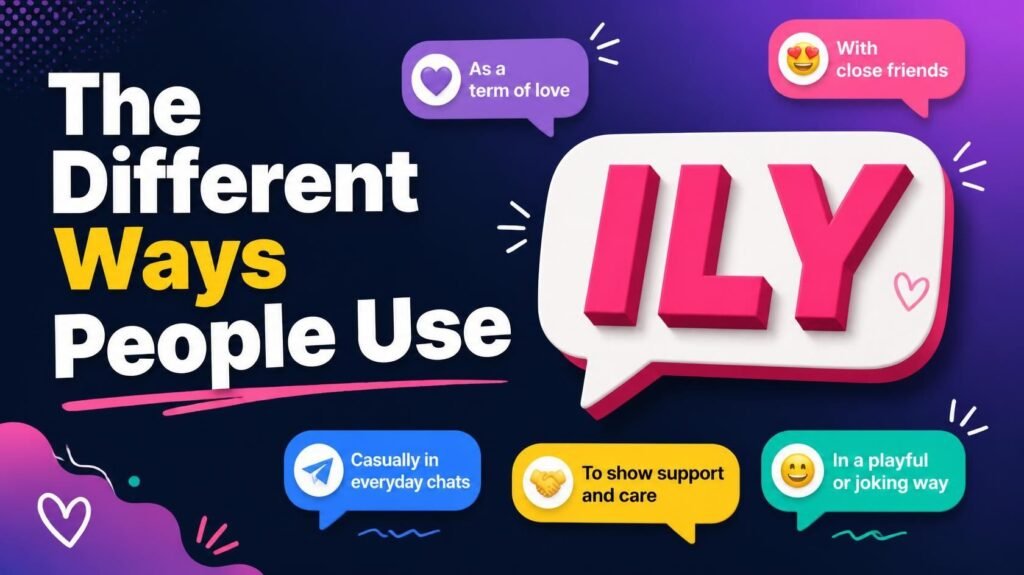
ILY doesn’t always carry the same emotional weight. Context, tone, and relationship help determine its real meaning.
A romantic ILY can express love between a boyfriend and girlfriend or other romantic partners. It may also appear when someone wants to show intimacy or strong emotional connection.
A platonic ILY works differently. Best friends, close friends, and mutuals may use it to show affection without romantic feelings.
A casual or playful ILY can appear after something funny, generous, or unexpected.
Three common types are:
- Romantic ILY: Love between romantic partners
- Platonic ILY: Affection between friends or family members
- Casual / playful ILY: Warm appreciation during a fun moment
Conversation example:
Friend: I covered your shift today.
You: ILY 😭
That message shows gratitude and affection. It doesn’t necessarily signal romance.
The same abbreviation can also appear with related expressions such as ILYSM, ILU, or ILY2. The intensity changes with each expression. Reading the room matters more than the abbreviation alone.
Real-Life Examples of ILY in Texting
Seeing ILY in a real conversation makes its meaning much easier to understand. What does ILY mean depends on who sends it, why they send it, and the tone of the conversation.
The same three letters can show romance, friendship, appreciation, or family affection. That’s why you shouldn’t judge the message by the abbreviation alone.
Common situations include:
- Romantic partners expressing love
- Best friends showing affection
- Friends reacting to something funny
- Couples saying goodnight
- Family members checking in
- Someone showing gratitude or warmth
Emojis can also change the feel. ❤️ and 🥰 often make ILY feel more affectionate. 😭 can make it playful or emotional.
Quick example:
Friend: Thanks for staying up and talking with me.
You: Of course. ILY 🤍
Here, ILY shows deep friendship and appreciation. It doesn’t necessarily suggest romance.
The best way to understand ILY is to consider the relationship, recent conversation, and overall tone.
Example 1 — ILY Between Romantic Partners

When romantic partners use ILY, the abbreviation usually carries a strong emotional meaning. It can express love, intimacy, reassurance, or closeness.
A boyfriend or girlfriend might send ILY after a meaningful conversation. They may also use it naturally while ending a chat or making plans.
Conversation example:
Partner: I’m really proud of you today.
You: That means so much to me. ILY ❤️
In this situation, ILY expresses romantic love and emotional connection.
You may also see stronger versions such as ILYSM, meaning I Love You So Much. That expression usually suggests a higher intensity level.
Romantic ILY often appears when:
- Saying goodnight
- Checking in during the day
- Celebrating an achievement
- Offering emotional support
- Ending a conversation
- Expressing gratitude
However, ILY doesn’t have to sound dramatic. Sometimes a simple ILY carries more warmth than a long message.
The surrounding conversation gives the abbreviation its real weight. Context matters more than capitalization or punctuation.
Example 2 — ILY Between Best Friends
Best friends often use ILY without any romantic meaning. In this setting, it usually shows platonic ILY, strong friendship, appreciation, or emotional support.
A bestie might say ILY after listening to a stressful story. Another friend might send it after doing something thoughtful.
Conversation example:
Bestie: I defended you in the group chat. Again. 😭
You: Stoppp, ILY bestie 🤍
Here, ILY bestie clearly shows friendship and appreciation.
You’ll often see this kind of message in:
- Instagram DMs
- Snapchat
- Discord
- Group chats
- Text messages
The expression can also become playful. For example, someone might write ILY after receiving food, getting help, or hearing a funny joke.
That doesn’t make the feeling fake. It simply gives the phrase a lighter tone.
So, what does ILY mean between best friends? Usually, it means genuine affection without romantic intent.
Example 3 — ILY After a Funny or Kind Moment
Sometimes ILY appears because someone did something funny, sweet, or unexpectedly helpful. In these moments, the phrase often works as an affectionate reaction.
Imagine a friend saves you the last piece of pizza. You might respond with ILY even though you aren’t making a serious declaration of love.
Conversation example:
Friend: I saved the last slice for you. 🍕
You: ILY 😭 You are the best.
Here, ILY communicates appreciation and warmth. The situation makes the meaning clear.
You might use casual or playful ILY when someone:
- Makes you laugh
- Helps you with something
- Sends your favorite meme
- Brings you food
- Gives you useful advice
- Does something unexpectedly kind
Emojis can strengthen this playful feeling. A message like ily 😭 often feels more casual than a carefully written I Love You.
This is one reason texting abbreviations can feel flexible. The same expression can carry different intensity levels depending on the moment.
Example 4 — ILY Said Goodnight
Saying ILY at bedtime is common among people with a close emotional connection. Couples often use it as a warm way to end the day.
Best friends and family members may also use it before going to sleep. The relationship determines whether the message feels romantic, friendly, or familial.
Conversation example:
You: I’m exhausted. I’m going to sleep now.
Partner: Okay, sleep well. ILY 🥰
You: ILY too. Goodnight ❤️
Here, ILY adds affection to an ordinary goodbye. It turns a simple ending into something warmer.
You might also see:
- ILY2
- ILY too
- ILY more
- ILYSM
- ily 🤍
ILY2 means I Love You Too. It commonly works as a direct response when someone says ILY first.
However, you don’t owe anyone a reflexive reply. If you’re unsure, you can respond warmly without immediately saying it back.
Example 5 — ILY From a Family Member
Family members frequently use ILY to express love and reassurance. Parents, siblings, and other close relatives may include it in ordinary text conversations.
A mom might send ILY after checking in. A sibling could use it after sharing a funny memory. These messages usually express family affection rather than romance.
Conversation example:
Mom: Just checking in. Hope everything went well today.
You: It did. Thanks for asking, Mom. ILY ❤️
In this example, ILY communicates love, gratitude, and warmth.
Family ILY may appear when:
- Checking in
- Saying goodnight
- Celebrating birthdays
- Offering encouragement
- Saying goodbye
- Showing appreciation
The phrase can also appear in family group chats. Someone might write ILY all after everyone shares good news.
So, what does ILY mean from a family member? Usually, it simply means I Love You and reinforces a close family bond.
ILY vs Similar Expressions — What Is the Difference?
Understanding ILY vs similar expressions helps you choose the right texting abbreviation. What does ILY mean? It means I Love You, but related shortcuts can change the message’s intensity.
Here are common differences:
| Expression | Meaning | Typical Use |
| ILY | I Love You | Love and affection |
| ILYSM | I Love You So Much | Stronger emotion |
| ILYB | I Love You Both | Addressing two people |
| ILU | I Love You | Casual variation |
| ILY2 | I Love You Too | Returning affection |
| IMY | I Miss You | Longing or missing someone |
| 143 | I Love You | Numeric code |
For example, ILYSM can feel more intense than ILY. Meanwhile, ILY2 works as a direct reply.
Conversation example:
Partner: ILY ❤️
You: ILY2 🥰
A different exchange might look like this:
Friend: ILYSM for helping me today.
You: Aww, ILY too 🤍
These expressions aren’t interchangeable in every situation. Context, tone, and relationship still matter.
When Should You Use ILY?
Use ILY when you genuinely want to show love, affection, or appreciation. The right moment usually feels natural rather than forced.
ILY works well when:
- You want to express genuine love
- You’re thanking someone close to you
- You’re ending a personal conversation
- You’re checking in with someone special
- A friend does something thoughtful
- You’re sharing an emotional moment
The relationship should guide your choice. A romantic partner may understand ILY as deep affection. A best friend may read it as warm friendship.
Conversation example:
Friend: Thanks for listening to me tonight.
You: Always. ILY 🤍
That message feels sincere because the conversation already has an emotional connection.
However, don’t send ILY simply because someone else used it first. You don’t need to match their intensity.
The best approach is simple: use ILY when it reflects what you actually feel. Honesty makes the message more meaningful than perfect timing.
Perfect Times to Use ILY
Some moments make ILY feel especially natural. These situations already involve affection, gratitude, or emotional closeness.
Good opportunities include:
- Saying goodnight to someone close
- Ending a meaningful conversation
- Checking in with family
- Supporting a partner during a difficult day
- Thanking a bestie for being there
- Celebrating an important achievement
- Reacting to a funny or kind moment
- Showing appreciation after someone helps you
Conversation example:
Partner: You handled today so well. I’m proud of you.
You: Thank you. ILY so much ❤️
Another example works between friends:
Bestie: I brought your favorite snack.
You: ILY bestie 😭
Here, the expression can feel casual and playful rather than deeply serious.
You can also choose ILYSM when your feelings seem stronger. If you’re simply returning affection, ILY2 may fit better.
Pay attention to the relationship and tone. When the message matches the moment, ILY rarely feels out of place.
Times to Think Before Sending ILY
Although ILY is common, some situations require more thought. The biggest issue is context. A phrase that feels sweet to one person may feel intense to another.
Think twice when:
- You’re in a brand-new relationship
- You barely know the person
- The conversation has stayed casual
- You’re unsure about your feelings
- The other person may feel pressured
- You’re talking in professional settings
- You’re messaging a manager or client
Conversation example:
New date: I had a really great time tonight.
You: Me too. I’d love to see you again.
That response keeps things warm without saying something you aren’t ready to mean.
You should also avoid using ILY as a reflexive reply. If someone sends it first, you don’t owe them an immediate ILY.
In professional or formal settings, choose clearer language such as thank you or I appreciate your help.
Most importantly, don’t let overuse dilute the meaning. ILY works best when it comes from genuine honesty and authenticity, not habit or pressure.
Common Misunderstandings About ILY
People often assume what does ily mean has only one answer. In most chats, ILY means I Love You. However, the feeling behind it depends on the relationship and situation.
ILY can show romantic love. It can also express friendship, family affection, appreciation, or playful warmth.
Common misunderstandings include:
- ILY is always romantic.
- ILY has less meaning than I Love You.
- You must reply immediately.
- ILY and ILYSM have exactly the same intensity.
- Lowercase ily means the sender cares less.
Context matters more than capitalization. Look at who sent it, what you were discussing, and how they normally communicate.
Conversation example:
Friend: You seriously helped me get through today. ILY 🤍
You: Anytime, bestie. ILY too!
Here, ILY clearly shows friendship rather than romantic interest.
Misunderstanding 1 — ILY Is Always Romantic
One common mistake is assuming ILY always signals romantic feelings. That isn’t true. People use ILY with friends, parents, siblings, and other close people.
A best friend might write ILY after helping you. A parent might send it before bed. The meaning comes from the relationship and context.
ILY can express:
- Romantic love between partners
- Platonic love between best friends
- Family affection
- Appreciation and gratitude
- Warmth after a kind moment
- Playful affection in casual chats
Conversation example:
Friend: I brought you coffee because you looked exhausted.
You: ILY 😭 Thank you!
Nothing about this exchange suggests romance. It simply shows appreciation and affection.
So, when asking what does ily mean, don’t focus only on the letters. Consider the person, situation, tone, and emotional connection behind the message.
Misunderstanding 2 — ILY Is Less Meaningful Than I Love You
Some people think ILY feels weaker because it’s an abbreviation. That’s not necessarily true.
Typing three letters doesn’t automatically reduce the emotion behind them. Someone can sincerely write ILY and mean every word.
The difference is usually about communication style.
- ILY feels quick and natural.
- I Love You feels more deliberate.
- ILY can fit casual texting.
- I Love You may feel more serious in certain moments.
- Both can communicate genuine love.
Conversation example:
Partner: I just wanted to remind you how much you mean to me.
You: ILY ❤️ More than I can explain.
The short form can still carry deep affection. On the other hand, using ILY constantly without thought might make it feel routine.
The real meaning depends on sincerity, timing, relationship, and tone rather than the number of letters.
Misunderstanding 3 — You Have to Say It Back Immediately
Receiving ILY doesn’t create an automatic obligation to reply with ILY2. Your response should match how you genuinely feel.
Sometimes you’re surprised. Maybe you’re not ready to say it. You might care deeply but need time to process the message.
You can respond honestly without creating awkwardness.
- I really care about you too.
- That means a lot to me.
- You’re very important to me.
- I’m not ready to say that yet.
- I appreciate you telling me.
Conversation example:
Person: ILY. ❤️
You: That means a lot to me. I’m really glad you’re in my life.
You don’t have to force an emotional response. A reflexive ILY2 may create pressure if you aren’t ready.
Understanding what does ily mean also means understanding the emotional responsibility behind it. Honest communication is better than saying something you don’t truly mean.
Misunderstanding 4 — ILY and ILYSM Mean the Same Thing
ILY and ILYSM are closely related. They aren’t always identical in emotional intensity.
ILY means I Love You. ILYSM means I Love You So Much. The second version adds extra emphasis and can feel warmer or stronger.
Think of them as different levels of expression:
- ILY — direct affection
- ILYSM — stronger emotional emphasis
- ILY2 — I Love You Too
- ILU — casual variation of I Love You
- 143 — numeric texting code for I Love You
Conversation example:
Partner: I can’t wait to see you tomorrow.
You: ILYSM 🥰
A simple ILY could work too. ILYSM simply adds more intensity.
So, when someone asks what does ily mean compared with ILYSM, the basic message is similar. The emotional emphasis can be different depending on tone and context.
How to Respond When Someone Sends You ILY
Your response depends on your feelings and your relationship with the sender. You don’t need to copy their exact words.
If you feel the same way, a simple ILY too works well. You can also make it warmer with ILYSM or ILY more.
If you’re unsure, keep your response honest and gentle.
If you feel the same:
- ILY too ❤️
- ILY more 🥰
- ILYSM!
- Love you too.
If you’re unsure:
- That really means a lot to me.
- I care about you so much.
- I’m glad you told me.
Conversation example:
Person: ILY 🤍
You: ILY too. I’m really lucky to have you.
Or:
Person: ILY ❤️
You: Aww, that means so much to me.
Understanding what does ily mean can help you choose a response that fits the moment instead of reacting automatically.
Pro Tips for Using ILY the Right Way
ILY works best when it feels natural. Don’t send it simply because someone else expects you to.
Think about the relationship before using it. A romantic partner, bestie, parent, and coworker may need very different language.
Keep these tips in mind:
- Read the room before sending ILY.
- Consider your relationship with the person.
- Use ILY when you genuinely feel affection.
- Don’t say it too early in a new relationship.
- Use emojis when they fit your normal style.
- Don’t overuse it until it loses its emotional weight.
- Avoid ILY in formal work conversations.
- Don’t feel pressured to return ILY immediately.
- Choose ILYSM when you want stronger emphasis.
Conversation example:
Bestie: Thanks for being there for me.
You: Always. ILY 🤍
The best answer to what does ily isn’t just I Love You. Its real meaning comes from honesty, context, timing, and the connection between two people.
Frequently Asked Questions About ILY
What does ILY mean in a text message?
What does ily mean? ILY stands for I Love You and shows love, affection, care, or appreciation in casual messages.
Is ILY only used in romantic relationships?
No, ILY can express friendship or family love too. What does ily mean depends on your relationship and conversation.
What is the difference between ILY and ILYSM?
ILY means I Love You, while ILYSM means I Love You So Much. What does ily mean can feel less intense.
What should I say when someone texts me ILY?
If you feel the same, say ILY too. If unsure, respond warmly without pressure while considering what does ily means.
Final Thoughts
Now you know what does ily mean and why people use it in daily chats. ILY usually means I Love You. It can show romantic love, friendship, family affection, or simple appreciation. The real meaning depends on the person and situation. So, when you ask what does ily mean from someone, look at the full conversation. Their tone can tell you more than the three letters.
Knowing what does ily mean also helps you reply with confidence. You can say ILY too when you feel the same. You can use ILYSM for stronger emotion. If you’re unsure, you don’t need to rush your reply. A kind and honest response works well. Remember, what does ily mean isn’t always romantic. Context matters. Whether it comes from a partner, bestie, or family member, what does ily often carries warmth, care, and genuine affection.

Noah Daniel Davis is a professional writer and language enthusiast who creates clear, engaging content about word meanings, vocabulary, phrases, and everyday expressions. His goal is to make language simple and easy to understand for every reader.
